This is post is continued from an incomplete draft early in September 2008 and it is only apt that this post be published now, with a complete flavor of the Pareto rule in B-Schools!!!
The Pareto Principle, or the alternatively famous 80-20 rule, has been interpreted in the most mundane ways possible. I was oblivious to the greatness and versatility of the rule before I landed on the gates of a B-School. As life at B-school started sinking in, Pareto’s interpretation opened new avenues for conjuring 80-20 relations in many obscure ways. Let me try to put into words, the endless minutes of daydreaming to bring up few of the 80-20s, which I believe make life at B-schools really interesting.
80 percent of the batch is male, generating 20% interest in ice-breaking and the remaining 20%, even if it does not consist of that hot girl you met during your GD-PI, gets 80% attention in ice-breaking activities.
80% of the gyan comes from 20% of the seniors, while the remaining 80% sit back and enjoy as juniors are mercilessly slaughtered by these zealots,
Alternatively, after the first 10 days, 80% of the gyan is taken by only 20% juniors and the remaining 80% are deaf by this time.
80% doubts in class arise in the minds of 20% of the student, while the remaining students are content with sleeping (or dreaming up such stuff!!!)
All the team projects will be split in the 80-20 rule as follows:
80% of the PPTs are made by a single person
80% of the presentations are presented by a single person
80% of the data analysis will be done by a single person
100% of nothing will be done a very special single person
80% of your time in a term will be spent on a single subject which ends up contributing only 20% to your CPI
As the summer internships come to an end, 20% of the batch has an 80% probability of landing a PPO/PPI while the remaining 80% have a combined 20% of doing so
Come placement time, only 20% junta has an 80% chance of landing up in their dream job while remaining 80% looks to split the remaining 20% in the best way possible.
If an interviewer is smiling at your answer then 80% of the times he has found a way to nail your backside on the crucifix the remaining 20% he doesn’t have a clue as to what you are saying
And finally, 80% of the people who have read till here have no clue what this was about and the remaining 20% are out searching for me!!!
This one originated right this evening.
It was started by my bro GuGu ofcourse, with whom I have the pleasure of sharing many intellectually intense and invigorating debates... and all this while watching a dismal game of cricket. No, I am not refering to the 'ordinary' India-Bangla test match but to a game of cricket commonly known in the balconies, passages and verandahs of India as one-tip, one-hand cricket.
As to the origin of the name, there have hardly been more to-the-point names in the world, which leave you in no doubt as to the game ( I wish human names were as useful!!!). However, the debate did not rest on the mere nomenclature of the game rather hinging on a more intriguing part of the game. How is it that the rules for 1t1h cricket (1-tip 1-hand cricket..inspired by T20) are more or less the same across the country?
As is often the case, I began my answer in all earnest abstraction and hoped to end my monlogue with the famous "Elementary, my dear Watson" look. However, ever since I have been solicited for services by a name sake of the Jaya Prakash Murugan Chettiar Bank, the time on my hands has enabled me to delve deeper on entirely useless things!!! ( You might wish to argue that it was the case earlier too but let save it for later.)
So I took up the development of 1t1hcricket as a management problem and this is how I guess it must have worked out:
Need Identification: In India everybody wants to play cricket but hey, where is the space!!! So every possible quadrangular (or not so quadrangular space..) is put to good use. Now we Indians are competitive people and no cricket can happen without elaborate scoring systems and even more ritualisitc methods of getting out. Thus, the birth of 1t1h cricket owes itself to the space-strapped cricket maniacs of the country.
Early Adopters: Early adopters are the people to whom any product might give reasonable amount of credit for shaping usage patterns and augmenting product features. So while 1t1h started out as a simple variant, the early adopters to the game decided to add rules for hitting on the wall, hitting the tubelight, minimum runs in an over etc etc etc and more... thereby increasing the ability of the game to handle various tricky situations and obstructions.
Critical Mass: Many new product innovations have perished because of their ill-timed launches. While market timing is as much an art as a science, the rise of 1t1h cricket has coincided with the emergence of housing complexes, having more parking space than playing space (infact substitutable spaces... these two!!!). More controlling parents, who figure children are safer playing cricket in the balcony of their 8th floor apartment than on the ground and of course, the simple truth that any playground is hideously anti-social compared to filling the coffers of some builder bloke. Add to this the stereotypical picture of a cricket field in India.... 5 parallel pitches and close to 100 fielders packed into a regular size field. While the batsman's concerns are not limited to the opposition fielders alone but expand to include the pitch invading goons from other teams, the poor fielders have the additional worry of protecting their nether regions from a well directed pull shot. Hardly a pleasing sight you would say!!! Thus, the new baby in the cricketing world couldn't have come at a better time.
Standardisation: While many sports in India have secured an elitist status, its just impossible to keep any form of cricket away from the masses. Though in essence this penetration of the product into new market segments should be a good news for most firms, it also brings in the additional burden of standardisation. And I guess, we have no one to thank more than the kids of Defence personnel & other folks in transferable jobs for bringing about this standardisation of procedures/rules/rituals and other gimmicks in the sport of 1t1h cricket. These people have travelled far and wide, carrying with them the best practices in the sport and spreading it across the various parts of the country. Thus, many of the rules in the sport are now universally (read "nationally") accepted.
With this my analysis of the evolution of the sport has been concluded and all I now worry about is the survival of the game. You see there was this game we played as kids, it was called book cricket but with the advent of PDFs, laptops and Kindle the children of today have been deprived of the sheer thrill and adrenaline of playing the great sport of book cricket. I hope 1t1h does not meet such an unceremonious end. Amen!!! ======================================================= The above gyan is written without any backing of management studies. It is just a intuitive piece of imagination of how things might have worked out at a micro level, at the same time causing a sea change in the cricketing behavior of an entire nation. Believe it at your own risk!!!
The entire IIT Bombay campus is getting up from the sleepy hangover of Mood Indigo 2009. An extravaganza in itself, it deserved a fitting finale, a finale as delivered by the awesome trio of Shankar Ehsaan and Loy on the last ProNite show of MoodI last night. The entire OAT was up and rocking for 2 hours as we sang ourselves hoarse and danced till the body could take it no more. At that point I could never have thought that anything else could go one up on that show that evening. But then there was the premiere of Mr. Perfect Khan's "3 Idiots" to contend with!!!
Well not many Bollywood movies move me enough to write a blog post about them, and those which have done are for all the wrong reasons but "3 Idiots" deserves to written about, talked about and felt good about so here goes....
To start off, the passage to the movie hall itself was a thriller, what with a hitched ride to the IIT Main Gate and a Bollywood ishtyle sprint to get on to the running bus, all of which enabled me to reach the place about 10 mins in advance. Only one thought ran in my mind ...this movie better be worth all the running around!! But after having read Chetan Bhagat's 5 Point Someone, frankly my expectations weren't very high.
But then if we take one of the finest acting talents in Indian cinema and mix it with the directorial talent of the legendary MunnaBhai series, fireworks are guaranteed.
3 Idiots has masterfully uncovered the dirty underbelly of the Indian education system. Right from unrealistic parental expectations and peer pressure all the way upto some of the drastic steps that students are forced to take, all of them have been dealt with seriously, delicately and passionately.
The storyline is not straight of the novel, which is good and makes it a TRUE 'adaptation', with a few unexpected twists and turns. The screenplay is crisp and the songs make sense ( and will be on your lips, on your way out!!!), and probably the only place where the script falters is towards the end, where the entire childbirth scene is a bit too much to handle. Apart from that I guess there are no gaping flaws in the movie.
Coming to the actors, well.... singing anymore praises to Amir is a waste of time because we have come to expect him as being nothing short of real, fresh and brilliant. To quote Amir aka Rancho from the movie itself... "strive for excellence and success will follow you around." and he has proved himself right. Madhavan as the narrator is restrained and yet full of energy, while Kareena as Pia is a deadly combo of sweet and sexy!!! After seeing him play the dean in Munnabhai, one would have thought that Boman Irani couldn't go one better but he has actually outdone himself with the potrayal of Virus, a hugely competitive and eccentric professor but also a defeated father. The chap who does the role of MadanMohan..or Millimeter is also good.
But for me the best performances came from Raju Rastogi (Sharmaan Joshi) and Chatur Ramalingam. Typical rags-to-riches boy, Raju is torn between his responsibilities towards the family and his loyalty to his friends and this internal conflict is reflected in all his actions in the entire movie. Sharmaan's ability to make those straight faced jokes really brings alive the character even though some of the jokes in the movie are oft-repeated college humor. Chatur Ramalingam is the quintessential padaku, a person who has mastered the current system and is so sure of tiding over any anamolies like the 3 Idiots with supreme arrogance and sheer weight of memory power. However, like all good Hindi movies, the supremacy of our hero is emphatically stamped on this rote-machine and he accepts defeat with a traditional salaam at the end. The balatkar speech delivered by Chatur will surely become part of college folklore for years to come.
The Kareena-Amir chemistry deserves special mention for its vibrance and "chooo-chweeet" factor. So much so that by the end of the movie you are almost rooting for Kareena to slap him and seal it with a kiss ( which she does). And to think that moi was sceptical about the pairing initially!!!
Who should watch the movie?? Well almost everyone, the junta studying in engineering colleges, people passed out of engineering colleges, people who couldn't make it to engineering colleges and of course, all the parents who decide at their child's birth as to what their child should become.
Amir and Raju Hirani have given us a great movie to savour and also maintained their tradition of delivering a strong message underneath a light, fun-filled experience.
As we all agreed last night after the movie... it gets a 4 out of 5 and is a must watch for everyone in the country!!!
"Ohh Bhaiya.. Aal izzz Well!!!"
The post was written on the day Govt declared creation of the Telangana state. The delay in posting was caused by lack of access to Internet.
================================================================== This is the third consecutive day when I am posting on my blog. Understandably the amount of time on my hands is worrying for both me and the Saptarishis. Infact in relation to my previous post, I confided to a close friend that becoming a writer is a serious career option. But then that was yesterday. Today, of course, India and the world woke up to one of the boldest blackmail heists in the history. As if right out of a Calvin & Hobbes strip, an unruly kid foregoes his meals to get a better Christmas gift and the hapless parents agree. And, of course, that carving out Telangana will motivate other such power-hungry ruffians to go on a fast and demand smaller states from the existing ones, is none of the Central Government's business. I guess given the current state of 'bovine excrement' the Centre has landed itself into, is the perfect impetus for all the separatist movements. An the potential outcomes of their 'humble' requests can be quite interesting, coming primarily from some of the most productive lunch table group discussions. Lets have a look at some of them:
Possibly, we'll end up 545 states, where each constituency is a state in itself. We'll hv a small matter of 500+ state governments, potentially be renamed "The United States of India". Sounds cool, Sardar Vallabhbhai Patel's hardwork done to dust!!!
How about a spate of Union Territories, acting as regional headquarters and you can form whatever number states you want. So Mumbai is separate from Maharashtra, Hyderabad is separate from AP (Telangana..go figure this one!!), Bangalore is separate from Karnataka. I am sure the kids in school will hate it.. Imagine the enormous amount of gyan they'll have to memorise because of our politicians, some of whom actually never bothered going to school anyways.
Third, and this I find to be the most plausible, is the case for dual citizenship. I am sure this gives one Mr. Thackeray a smile on his face. People moving between states will have visa interviews and will have to clear exams with fanciful names like Test in Tamil Speech (who's acronym can't be written here!! Imagine if you had a guidebook to the exam saying "Ace your T&^*") or Test of Marathi as Professional Language.
What if the motivation for creating states changes? Currently states are formed according linguistic, cultural and of course, political considerations!! Imagine what happens if professional considerations are taken into account. What if the huge mass of software engineers strewn across country goes on a hunger strike demanding creation of niche states only for IT professionals? What will be the name of this state ... Soochna Pradesh will be unacceptable to the Madrasi anna while IT Nadu will be indigestible to the bhaiyaji!!! Some problem there. One thing is for sure Mark Zuckerberg will be proud!!!
Probably we could also pack up all these useless separatists into one state and build huge fences around it so that no one ever escapes from there to more conundrum in India. In the meanwhile I am planning to go on a hunger strike demanding creation of a state for all Priyanka Chopra fans!! Can anybody tell me if this wish will be granted?? Plz Mr. Prime Minister!!!!
As I mentioned in my previous post, it is indeed disturbing that I have so much time at my disposal. With the approaching placement season, we are all to work our posteriors off figuring out the nitty-gritties of Finance and try our best to untangle the mess of HR (Hamara Rape) questions. And rightly so, I must add. From the interactions I have had with members of the industry and my brethren from the student community, it actually seems that Mr. Porter and his famed 5-forces of bargaining power have undergone a tectonic shift in the recruiter-recruit landscape. Bad timing one would say but as is my wont to take a look at things from unusual (read useless) perspectives, let us try and understand how the fina preparation of a final year MBA student would vary from the Good to the Bad times. Before starting on this rather controversial, and yet soul-searching, quest lets set some benchmarks to demarcate the Gooooood times from the Bad ones:
Good times are HR-killers, Bad times are Placecom-killers
Average packages are cooked up in Good times, they are cooked harder in Bad times
Good time gossips include packages, locations, profiles, parties, Bad times gossip is just one question "sab place ho jayenge?"
In Good times entrepreneurship is a fad, in Bad times it is a different perspective of looking at life
Apart from remonstrating on the various differences that exist between the Good and Bad times, I did get one striking similarity in the two times. The preparation enthu of the students. Yes, come what may the students have distinct apathy towards "placement preparation". The Good times cause this phenomena by virtue of the euphoria surrounding everything in the world while the Bad times bring upon you a depression, almost resembling decay. Most of the time is spent researching (read Google-ing) the Web in search of some arcane topic, which eventually gives way to "Top 10 ______ movies of all time" where _______ is filled by a particular genre, depending on your mood. In Good times, the genres are comedy, romance while in Bad times the focus is on drama and crime (possibly as an alternative career choice!!). While the students live between meals, new passions like untried sports, photography, poetry (the sad type, especially) are cultivated, which we hope will earn us brownie HR points. Sleep knows no upperbound while all the requisite books are neatly stacked near the bed, untouched. Come Boom or Bust boss... we are the King of all times... Good or Bad who cares!!!
If I remember well, it was Mark Twain who once lamented on the ignominy of sitting helplessly in a dentist's chair. The other day I experienced the same sense of powerless subjugation while sitting in the chair of none other than our campus barber.
Somehow these trivial incidents make me think deeper than usual, a skill that can be disturbingly attributed to the amount of free time at my hands. My chain of thoughts centred on my impatience, helplessness and of course, the implications of a bad haircut on the impending placement season performance (how can that be missed!!!).
Ever since a boy reaches class 3 ( this is a hypotheses i am working hard to prove.. for now u can take my word for it!!), he is taught by his environment to be the alpha male, the uber cool and the person in control. Seldom of course are guys taught the opposite... to put complete trust in somebody else to handle the situation. And yet there are so many situations where the alpha male concept goes for a toss. The surgeons are a case in point. Not only does their hand writing beat you so does their talking. All you understand is that you are gonna be cut up and set alright. But then the alpha male is no less troubled by the barber. And you can see the parallels between a surgeon and a barber.
You have no clue if they understand your case and are qualified to handle you.
You can only pray to God when they wield their instruments
You have to bear the brunt of their mistakes
Finally, you hear so many horror stories about both professions, doing to something to someone, who was a friend of somebody
Except for the first question, "cutting karna hai?" not many performance guidelines are sought by them and given their destructive nature of work, questions like "zyada chhota ho gaya kya?" are rendered immaterial. Infact delving deeper into the topic (as the barber was closing in on my scalp!!) I started regretting the existence of the barber himself. Our ancients could have certainly done with the advanced surgeons but i hope whoever invented this concept of barber-ism (pun intened) is roasting in the deepest furnaces of hell.
Some of my friends might argue the futility of this post, coming from me, a potential heir to lot of real estate on my scalp (read "baldness"). But again, my ample time and imaginative thinking was already creating arguments as to why this helpnessness in the barber's chair is a sign of other potential problems areas for me.
Suddenly a voice broke out.."Saheb ho gaya, aapke zyada baal nahi hain na, isliye aur chhota nahi kaat sakte!!!" Great, apart from keeping me in mortal fear of disfiguration, this guy also decides to take potshots at my hair (or the lack of it!!).
"Haan haan theek hai..kitna hua?"
I duly paid him the 30 bucks and vacated the chair, just as thoughts of therapy, herbal oils and wigs engulfed the space vacated by the alpha male, barber-ism and other utopian philosophies.
The following forms part of the work I did with AB, Sushant and Mandar for the Net.Works competition at Confluence'09 IIM-A. Though the actual paper is more detailed I thought of posting some musings I had while working on the topic..... feedback is welcome
======================================================================
“Any sufficiently advanced technology is indistinguishable from magic”
– Arthur C. Clarke
Indeed to a person from a few decades back, the idea of connecting with lost contacts, collaborating across geographical boundaries and obtaining expert advice on a universe of topics, all at the mere click of a mouse would have seemed magical.
Today we live in a world of increased connectivity, more computing power and more social networks. Originating as a fad across college campuses in the United States, Facebook now has more than 300 million users, using 70 languages, half of which login atleast once in a day. The average user has 130 friends and 2 billion photos are uploaded each month on the site even as more than 70% of its user base resides outside the United States. Mind boggling numbers aren’t they and yet we have just talked about only one of the leading social networks of the world The proliferation of social networking websites in the past three to four years has led to the widespread discussion on the future size and form the networked world.
As every individual discovers the power of “communities” and innovative entrepreneurs take notice of latent business opportunities, the question that begs answering is will social networking remain the same, even a few years down the line? Will it become a substitute for the human interaction just as the email has killed the picture postcards? In a culturally diverse country like India, what will be the look and feel of social network with 500 million users? Are the current channels of delivering the network value sufficient or will see a radical shift in the way social networking happens in the years to come? What about the content offered to social network users, will we be happy updating statuses and sharing photos or do there exist opportunities to create new services, new applications and possibly even, new avenues to network in? How will the government and policy makers respond to this avalanche of information and public opinion?
The user experience on any social networking site will arise from a set of contributing factors. Each user will find his ideal experience from a unique combination of these contributing factors. So while we do try to create a scenario for the ‘ideal’ user experience, our task should be list out the contributing factors and figure out how they interact with each other, how they can be tweaked for each user.
In trying to understand I tried to list down what I feel would be the contributing factors, please feel free to add on or debate upon any of the existing items. The factors are:
accessibility – how do I get access to the platform
UI-- how does it look when I log in and when I am using the platform
Applications – okay so I have logged in, what do I do now, how engaged am I in the platform and what it has to offer.
Security – How secure is my profile, my data and what control do I have over this exposure
Network effect – how many people I know are on the platform, how connected am I with these people
Diversity of the content – for 500 million people a plain English medium will not suffice nor will they be content with their preferred language
The accessibility is aspect would come into the picture because imagining a broadband penetration in India of 500 million is impossible and we are probably talking about mobile access, not only through WAP and GPRS but potentially even through voice and text apps. The medium of usage will heavily impact usage experience.
The apps part will include photo/video sharing, games, quizzes and other forms of content creation. This is an area where I feel lot of futuristic thinking is applicable and our survey findings have revealed insights into the broad fields on which the future apps could/would/should concentrate.
UI will be an important aspect of experience coz while it needs to be crisp and uncluttered it should also bring forth all the functionalities that are present on the platform and there is a potential use of analytics to see what kind of UI should be made available for what kind of user.
In the area of security we might be looking at futuristic account verifications like biometric systems, especially if we are talking about financial transactions happening on the platform.
As mentioned the network effect will involve my interaction with other members of the platform, my friends, family and members of online communities. The concept of collaboration and how futuristic we are in imagining the collaborative levels will determine how we use this factor to create the intended user experience.
Finally, diversity of content is a factor/challenge that is very India-specific because of our cultural diversity. I am looking at multi language support, real time context based translation and other such opportunities.
Unlike what I had set out to do in the beginning, writing about my ideal user experience, I thought this way of looking at the problem might also provide some insights to what we are trying to do.
What I have been unable to accomplish here is to state the interactions between various factors. For example, the more the modes of access, the greater will be the security risks. Similarly I think we can come up with more offsetting scenarios where some sort of compromise has to be struck. If you guys think this approach might lead some where then that would be a potential candidate for further analysis.
Once we have explicitly (or at least with some level of clarity) expressed the interaction levels of these factors, we might go about discussing how to tweak them to satisfy various user classes (we might have to do some user segmentation in this regard)
Apart from thinking of more ideas to enhance the social networking experience of the future network, I think it would also be a great value addition if we could provide a theoretical framework for future developers to understand how the network can be enhanced to improve the user experience.
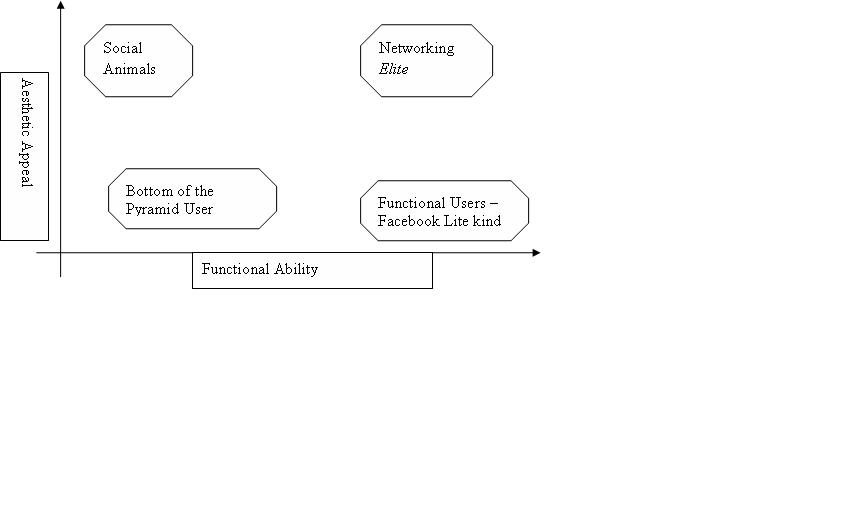
Going back to the six factors which I had mentioned before the ideas, I feel we could land up with some kind of user segmentation on the basis of these factors. Thus, we can club the six factors into two major categories as follows:
a.the intangible/aesthetic aspect: consisting of the UI experience, content diversity and the network effect
b.functional aspect: consisting of accessibility, availability of apps (easy navigation) and security
Thus the total user experience = aesthetic appeal x functional ability
IDEAS
Carrying on from the above thoughts, I have few ideas, which can potentially improve the UI experience of the user and also be monetized for financial viability.
Theme based UI: Though theme based UIs are already available and for free, the idea is to link ads for theme related activities and goods with the themes to create a holistic package which will then be available to the user. While the user uses the theme for free, the theme creator gets paid by the advertiser and the platform gets a share of the revenue based on the usage of the particular theme. While the theme creator is free to invite as many advertisers on their themes, they have to balance it with keeping the UI experience simple and unobtrusive to ensure user acceptance.
For example, with the growing following of Barclay’s Premier League in India, suppose the user in India is a fan of the Manchester United football club then he would select from one of the ManUtd themes available on the platform. The theme creators can tie up with advertisers of sports merchandise or agencies which can offer match tickets (with the possibility of these teams traveling to India in future). Taking this instance forward, it offers scope for the official website www.manutd.com another channel to reach out to its followers by broadcasting messages through widget based broadcast messages. Similar theme based activity can be used for popular artists, political and social causes etc.
Online Partying: While social networking gurus contemplate on the latent potential of the network, the origins of the phenomenon still reside in the fun and bonding aspect. So it is not difficult to imagine the potential of organizing online parties on the social media, with the DJ and related effects. The party can be by invitation, where you might need to authenticate your navigation onto a webpage, or simply walk-in, or click-in, and open for everyone in the network. The monetization model is similar to how it works offline, with a host bearing the expenses. The party-page can be visualized as having a shoutcast app, another app to post requests to the DJ and apps to create visual effects on the webpage, which will be visible to others in the party.
Similar to the offline scenario, this can give rise to party/event managers specializing in services for this genre of partying. The online party will be especially interesting for India as it has got a huge expatriate population and this provides them an occasion to join their families in the celebrations in a more personalized manner than just viewing a webcast.
P.S.>> Sorry for the images.. cdnt do a better job!!!