This is post is continued from an incomplete draft early in September 2008 and it is only apt that this post be published now, with a complete flavor of the Pareto rule in B-Schools!!!
The Pareto Principle, or the alternatively famous 80-20 rule, has been interpreted in the most mundane ways possible. I was oblivious to the greatness and versatility of the rule before I landed on the gates of a B-School. As life at B-school started sinking in, Pareto’s interpretation opened new avenues for conjuring 80-20 relations in many obscure ways. Let me try to put into words, the endless minutes of daydreaming to bring up few of the 80-20s, which I believe make life at B-schools really interesting.
80 percent of the batch is male, generating 20% interest in ice-breaking and the remaining 20%, even if it does not consist of that hot girl you met during your GD-PI, gets 80% attention in ice-breaking activities.
80% of the gyan comes from 20% of the seniors, while the remaining 80% sit back and enjoy as juniors are mercilessly slaughtered by these zealots,
Alternatively, after the first 10 days, 80% of the gyan is taken by only 20% juniors and the remaining 80% are deaf by this time.
80% doubts in class arise in the minds of 20% of the student, while the remaining students are content with sleeping (or dreaming up such stuff!!!)
All the team projects will be split in the 80-20 rule as follows:
80% of the PPTs are made by a single person
80% of the presentations are presented by a single person
80% of the data analysis will be done by a single person
100% of nothing will be done a very special single person
80% of your time in a term will be spent on a single subject which ends up contributing only 20% to your CPI
As the summer internships come to an end, 20% of the batch has an 80% probability of landing a PPO/PPI while the remaining 80% have a combined 20% of doing so
Come placement time, only 20% junta has an 80% chance of landing up in their dream job while remaining 80% looks to split the remaining 20% in the best way possible.
If an interviewer is smiling at your answer then 80% of the times he has found a way to nail your backside on the crucifix the remaining 20% he doesn’t have a clue as to what you are saying
And finally, 80% of the people who have read till here have no clue what this was about and the remaining 20% are out searching for me!!!
As I mentioned in my previous post, it is indeed disturbing that I have so much time at my disposal. With the approaching placement season, we are all to work our posteriors off figuring out the nitty-gritties of Finance and try our best to untangle the mess of HR (Hamara Rape) questions. And rightly so, I must add. From the interactions I have had with members of the industry and my brethren from the student community, it actually seems that Mr. Porter and his famed 5-forces of bargaining power have undergone a tectonic shift in the recruiter-recruit landscape. Bad timing one would say but as is my wont to take a look at things from unusual (read useless) perspectives, let us try and understand how the fina preparation of a final year MBA student would vary from the Good to the Bad times. Before starting on this rather controversial, and yet soul-searching, quest lets set some benchmarks to demarcate the Gooooood times from the Bad ones:
Good times are HR-killers, Bad times are Placecom-killers
Average packages are cooked up in Good times, they are cooked harder in Bad times
Good time gossips include packages, locations, profiles, parties, Bad times gossip is just one question "sab place ho jayenge?"
In Good times entrepreneurship is a fad, in Bad times it is a different perspective of looking at life
Apart from remonstrating on the various differences that exist between the Good and Bad times, I did get one striking similarity in the two times. The preparation enthu of the students. Yes, come what may the students have distinct apathy towards "placement preparation". The Good times cause this phenomena by virtue of the euphoria surrounding everything in the world while the Bad times bring upon you a depression, almost resembling decay. Most of the time is spent researching (read Google-ing) the Web in search of some arcane topic, which eventually gives way to "Top 10 ______ movies of all time" where _______ is filled by a particular genre, depending on your mood. In Good times, the genres are comedy, romance while in Bad times the focus is on drama and crime (possibly as an alternative career choice!!). While the students live between meals, new passions like untried sports, photography, poetry (the sad type, especially) are cultivated, which we hope will earn us brownie HR points. Sleep knows no upperbound while all the requisite books are neatly stacked near the bed, untouched. Come Boom or Bust boss... we are the King of all times... Good or Bad who cares!!!
The following forms part of the work I did with AB, Sushant and Mandar for the Net.Works competition at Confluence'09 IIM-A. Though the actual paper is more detailed I thought of posting some musings I had while working on the topic..... feedback is welcome
======================================================================
“Any sufficiently advanced technology is indistinguishable from magic”
– Arthur C. Clarke
Indeed to a person from a few decades back, the idea of connecting with lost contacts, collaborating across geographical boundaries and obtaining expert advice on a universe of topics, all at the mere click of a mouse would have seemed magical.
Today we live in a world of increased connectivity, more computing power and more social networks. Originating as a fad across college campuses in the United States, Facebook now has more than 300 million users, using 70 languages, half of which login atleast once in a day. The average user has 130 friends and 2 billion photos are uploaded each month on the site even as more than 70% of its user base resides outside the United States. Mind boggling numbers aren’t they and yet we have just talked about only one of the leading social networks of the world The proliferation of social networking websites in the past three to four years has led to the widespread discussion on the future size and form the networked world.
As every individual discovers the power of “communities” and innovative entrepreneurs take notice of latent business opportunities, the question that begs answering is will social networking remain the same, even a few years down the line? Will it become a substitute for the human interaction just as the email has killed the picture postcards? In a culturally diverse country like India, what will be the look and feel of social network with 500 million users? Are the current channels of delivering the network value sufficient or will see a radical shift in the way social networking happens in the years to come? What about the content offered to social network users, will we be happy updating statuses and sharing photos or do there exist opportunities to create new services, new applications and possibly even, new avenues to network in? How will the government and policy makers respond to this avalanche of information and public opinion?
The user experience on any social networking site will arise from a set of contributing factors. Each user will find his ideal experience from a unique combination of these contributing factors. So while we do try to create a scenario for the ‘ideal’ user experience, our task should be list out the contributing factors and figure out how they interact with each other, how they can be tweaked for each user.
In trying to understand I tried to list down what I feel would be the contributing factors, please feel free to add on or debate upon any of the existing items. The factors are:
accessibility – how do I get access to the platform
UI-- how does it look when I log in and when I am using the platform
Applications – okay so I have logged in, what do I do now, how engaged am I in the platform and what it has to offer.
Security – How secure is my profile, my data and what control do I have over this exposure
Network effect – how many people I know are on the platform, how connected am I with these people
Diversity of the content – for 500 million people a plain English medium will not suffice nor will they be content with their preferred language
The accessibility is aspect would come into the picture because imagining a broadband penetration in India of 500 million is impossible and we are probably talking about mobile access, not only through WAP and GPRS but potentially even through voice and text apps. The medium of usage will heavily impact usage experience.
The apps part will include photo/video sharing, games, quizzes and other forms of content creation. This is an area where I feel lot of futuristic thinking is applicable and our survey findings have revealed insights into the broad fields on which the future apps could/would/should concentrate.
UI will be an important aspect of experience coz while it needs to be crisp and uncluttered it should also bring forth all the functionalities that are present on the platform and there is a potential use of analytics to see what kind of UI should be made available for what kind of user.
In the area of security we might be looking at futuristic account verifications like biometric systems, especially if we are talking about financial transactions happening on the platform.
As mentioned the network effect will involve my interaction with other members of the platform, my friends, family and members of online communities. The concept of collaboration and how futuristic we are in imagining the collaborative levels will determine how we use this factor to create the intended user experience.
Finally, diversity of content is a factor/challenge that is very India-specific because of our cultural diversity. I am looking at multi language support, real time context based translation and other such opportunities.
Unlike what I had set out to do in the beginning, writing about my ideal user experience, I thought this way of looking at the problem might also provide some insights to what we are trying to do.
What I have been unable to accomplish here is to state the interactions between various factors. For example, the more the modes of access, the greater will be the security risks. Similarly I think we can come up with more offsetting scenarios where some sort of compromise has to be struck. If you guys think this approach might lead some where then that would be a potential candidate for further analysis.
Once we have explicitly (or at least with some level of clarity) expressed the interaction levels of these factors, we might go about discussing how to tweak them to satisfy various user classes (we might have to do some user segmentation in this regard)
Apart from thinking of more ideas to enhance the social networking experience of the future network, I think it would also be a great value addition if we could provide a theoretical framework for future developers to understand how the network can be enhanced to improve the user experience.
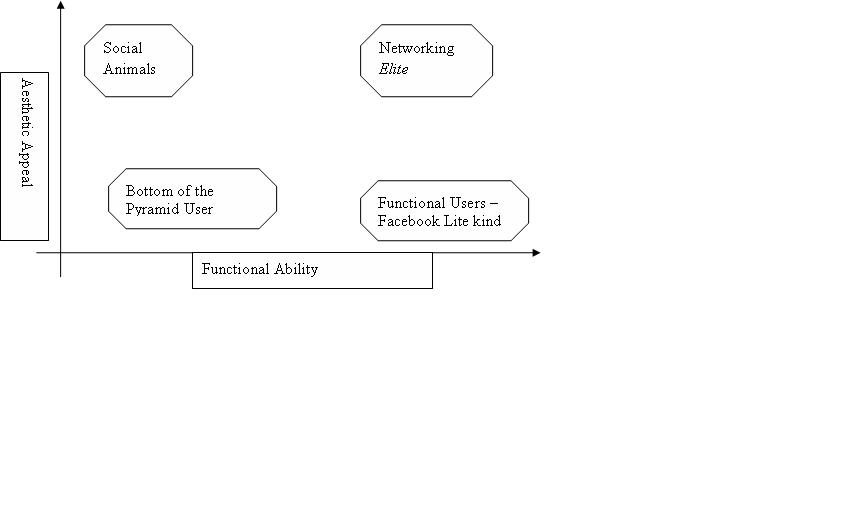
Going back to the six factors which I had mentioned before the ideas, I feel we could land up with some kind of user segmentation on the basis of these factors. Thus, we can club the six factors into two major categories as follows:
a.the intangible/aesthetic aspect: consisting of the UI experience, content diversity and the network effect
b.functional aspect: consisting of accessibility, availability of apps (easy navigation) and security
Thus the total user experience = aesthetic appeal x functional ability
IDEAS
Carrying on from the above thoughts, I have few ideas, which can potentially improve the UI experience of the user and also be monetized for financial viability.
Theme based UI: Though theme based UIs are already available and for free, the idea is to link ads for theme related activities and goods with the themes to create a holistic package which will then be available to the user. While the user uses the theme for free, the theme creator gets paid by the advertiser and the platform gets a share of the revenue based on the usage of the particular theme. While the theme creator is free to invite as many advertisers on their themes, they have to balance it with keeping the UI experience simple and unobtrusive to ensure user acceptance.
For example, with the growing following of Barclay’s Premier League in India, suppose the user in India is a fan of the Manchester United football club then he would select from one of the ManUtd themes available on the platform. The theme creators can tie up with advertisers of sports merchandise or agencies which can offer match tickets (with the possibility of these teams traveling to India in future). Taking this instance forward, it offers scope for the official website www.manutd.com another channel to reach out to its followers by broadcasting messages through widget based broadcast messages. Similar theme based activity can be used for popular artists, political and social causes etc.
Online Partying: While social networking gurus contemplate on the latent potential of the network, the origins of the phenomenon still reside in the fun and bonding aspect. So it is not difficult to imagine the potential of organizing online parties on the social media, with the DJ and related effects. The party can be by invitation, where you might need to authenticate your navigation onto a webpage, or simply walk-in, or click-in, and open for everyone in the network. The monetization model is similar to how it works offline, with a host bearing the expenses. The party-page can be visualized as having a shoutcast app, another app to post requests to the DJ and apps to create visual effects on the webpage, which will be visible to others in the party.
Similar to the offline scenario, this can give rise to party/event managers specializing in services for this genre of partying. The online party will be especially interesting for India as it has got a huge expatriate population and this provides them an occasion to join their families in the celebrations in a more personalized manner than just viewing a webcast.
P.S.>> Sorry for the images.. cdnt do a better job!!!
Despite my prolific presence on Twitter, I had a lingering feeling of neglect towards my primary passion of blogging here. So here I am at the doorstep of second year of management education in a stifling, congested hostel room ( which btw doesnt belong to either of the occupants) and all I want is to write something silly to appease my blogging appettite. We had our Finance Continuum today and we will be having the Marketing Continuum tomorow to round off a packed weekend and give the junior batch a taste of things to come. The list of speakers was, as usual, illustrious and the experience was enriching. Though I have somewhat become tired of people cribbing about the recession and how everyone's backside is aching because of it, a couple of fresh perspectives did emerge from the day's proceedings. One was that everyone talked about inclusive growth, something the policy makers have talked about since Independence and I have come to appreciate since my internship days. Secondly, a specific thrust on the SME space by the banking industry was also visible throughout the day. Glad to feel that I have worked and learnt some aspects of both these issues during my internship. There was also a huge hue and cry about the budget and to put in my 2 cents to the pandemonium, I guess the FM missed a trick or two by letting the deficit balloon, taking the excuse of the recessionary period. It would have been a good idea to set things rolling on Public-Private partnership, specially in sectors like infrastructure. I think an oppotunity for implementing infrastructure partnerships on the build-operate-transfer model and enhancing the environment for such partnerships to prosper, has been offered and it should not be passed up in favor of the tried and tested, albeit risky proposition of public spending. Thus, the government could have simulated demand and allowed private sector to participate in this effort to bring the country out of this hole. Finally, it was heartening to hear our junior batch asking enthusiastic questions to the speakers. Some of the questions were really wonderful and I am hopeful that it'll be a great experience for us during the next year.
Adios!!!
P.S: Am working a organisation structure for firms based on technology platforms.. haven't been able to finalise it. Once its done that would be my next post. so keep waiting... Meanwhile started re-reading the book "Arab and Jew" while at home and am going good with it. Lets see if I actually manage to finish it this time.
Just to prove that my blog isn't dead, I have comeback from nowhere to post this. Two major reasons for staying away for so long are, one that idiot FakeIPLplayer, because of whom, no other blogs were to be read or followed for the past 40 days and secondly, I began my summer internship at a leading organisation in the financial sector. Ironically enuff, the IPL's over and simultaeneously, my wall of patience has been breached by the rigours of the internship so I am back again to wreak havoc with words and give FIP a run for his shadowy money. Well, frankly, I got nothing against the company... they have been gr8 to me, right to the point of expecting me to deliver on all commitments in one month so that they can give me more learning assignments. Talk about "9-wives-1-month-pregnancy" but I have been humbled by their faith in the bumbling, stumbling buffoon that I am, who's job no. 1 during the internship is to get appointments from the concerned people and then adjust all prior appointments for this latest one. So wat put me really off today was the fact that after 3 weeks, when I want some guidance on the faint gleanings of a solution, I am told that I have been running behind the wrong the target segment. If I felt like a vegetable in my marketing lectures, I really felt like cowdung during this meeting. I cried out all four letter expletives, at the top of my voice, within my mind and eventually, slowly and almost in hushed tones, promised better results next time round, which, by the way, is day after. This event actually opened a barrage of emotions within me and hence, I decided to pour it out on this post. Dude, I mean seriously... the only good things that have happened to me in the last one month have been, number 1, the fact that I have befriended the DJ @ Jugheads, to the extent that he concedes one request per weekend for moi and number 2, I have discovered that weekend trips to Jugheads are also a license to ogle wolfishly at beautiful (read sexy, hot... and all other synonyms for stunners!!!) girls, who are least bothered about a random pack of pariahs salivating, while they down drink after drink. Coming to this point in my post, I suddenly remembered that its the month of May and that this month has historically been unkind to me, so probably its a fitting thing that this May of 2009 be no different. But sorry for the diversion, let me get back to my rantings so that you pervs can get enuff fun off it. So coming back to my work, there is not much of it actually. All I am supposed to do is to gather data and think about the data. I was, of course, dumb enough to ask around for data. It seems we are supposed to get the data but no one has a clue as to who is supposed to give the data. In this intense game of "ricocheting-balls" syndrome, alike pool, I have already been reminded of my limited time here and that I should now start thinking with watever data I have and let the remaining data, rest in peace. And so I start thinking now, which is somehow too big a task for me and all I can think of is the coffee machine, the water cooler, the loo and lunch time (not necessarily in that order). Funnily enuff, I luved the title of the project first up and was already dreaming of all the frameworks I could apply in this particular scenario, similar to our marketing case studies. All my dream of SWOT and Porter's 5 forces vanished eventually when I discovered that applying these would effectively dig my grave because I can never get enough data to defend half of the points that I had written on a sheet on the first day of project discussion. The paper was put to its best use next weekend, when I wiped off 2-3 thick layers of dust from the Bible by Mr. Kotler, thus effectively taking away 1 year of my MBA education with all the slime attached to it. From the dreamy-eyed expectations of becoming Mr. India to the real-life struggle of staying afloat inspite of the teen-guna Lagaan my summer internship has come a full circle in half the period. Of course, this is again in keeping with my company's theory of high expectations. Finally, what keeps me going. I have asked this question myself and the only answer I get for this is a glass of sugarcane juice and malai-wali lassi. =================================================================== P.S: All facts, statements, people and feeling are completely fictitious and modified suitably for reading pleasure. Their resemblance to any real fact, statement, person or feeling is impossible. If you still wanna believe this post I hold no obligations regarding setting things right later.
P.P.S: If you are wondering that why I have written such a post only to deny its truth, then keep wondering, its your own sweet time. I am off to make my 1baby with my 9 wives .. (all notional creatures)
Nothing infamous about this one. We have been having our own football league, which we call SOM Premier League (SPL), in the hostel 1 grounds over the past week. I am part of a team called the Thunderbolts and though we dint start off thunderously in the tournament, we have been able to find our feet after the initial hiccups. And it so happened that due to a manpower crunch, resulting out of corporate internship inductions, I got to play. I had played a total of 20 minutes in the last 3 games and that too in defense, something which I have never done. After much deliberation and strategising, I was asked where I'll be comfortable playing. In a team of 5, with one goalkeeper, you dont get much choices but still I ventured out and said," I'll play forward." Well, that really did change the evening for me. I dont remember the exact timings of all the goals but I do remember how I scored them. Atleast 2 of them were good and 2 were plain dumb luck, while 1 could be put down to a defensive lapse by opponents. As I told everyone present, I was just lucky to be at the right place at the right time. The scoreline at the end of the match read 5-2 for Thunderbolts, with all 5 coming from my boot (OK, one was a header, make that 4+1!!). I felt that if I could just hang up my boots and walk into the sunset of my footballing career I would still be happy (lolzzz!!! nt much of a career actually!!). Anyways, most importantly, I had loads of fun and tons of laughs as I recounted the goals in my mind and probably thats wat counts the most. To borrow a term from my friend Ajit... Joga Bonito!!!!
Talking of Ajit, we have discovered our very own combination of Steve McMahon, Paul Masefield and Shebby Singh in this bloke. I wonder if he should take up sports journalism in all the right earnest... this is wat he had to say about the match...( mind you he was the opponent so the accolades are all the more special!!!)
A 5 star Parsu performance
It was Parsu's day out on the field as an unprecedented 5 goals from himhelped Thunderboltscrush Gunners 5-2. The manner in which the goals were scored were noteworthy with eachone being different from the previous. Although a couple of them were scored as a result of thegenerosity ofGunners defence, whose performance left a lot to be desired, the first of his five stood out for his positioning and deft touch. A goalmouth scramble following a corner led tothe ball rolling to Parsu who had stationed himself at the farpost, one deft touch and it lobbedover Amit into the Gunners' goal. That opened the flood gates as Parsu completed the hat-trick in just 18 minutes, a record that will surely stand for many SPL seasons to come.
The Gunners showed signs of a comeback with Ajit pulling a goal back at the start of the second half. However, a bad mistake at the goal post led to them conceding a very soft goaland the match was all but over. Bala soon made it two for the Gunners but it was all too late. The limelight belonged to one man. With this wonderful SPL performance, he has surely qualified forthe next GPL session.
An article originally intended for L!VE, our student magazine @ SJMSOM:
Working in one of India’s leading software services exporters, what will be your reaction if you were to be transferred to Belapur? Confused. You shouldn’t be, if these are any indications of the times to come. Welcome to the next generation of expansion in the software service industry. The software industry of Bangalore, Mumbai and Gurgaon is now moving deeper into the country. The new centers of information technology are no longer the big metros but low cost centers like Jaipur, Trivandrum and Chandigarh.
Unsurprisingly, the high cost of operation in the metros coupled with the high rates of attrition prevalent among the leading companies has made them look other places for a better option. The Tier II cities have a distinct advantage in this regard for many companies. The reported cost differential is around 10 percent for non-voice based services and higher for voice based services create a huge margin of operational profits for the firms. Also, thanks to the large population of the country and increasingly effective education system, the number of university graduates coming from these cities is enough to take care of the major manpower requirements for the companies.
All major outsourcing companies have scouted out new locations, away from the hustling bustling metropolitans to locales such as Kochi, Baroda and Coimbatore etc. These include companies like Wipro Spectramind, Infosys Technologies and Cognizant Technology Solutions. Kochi and Coimbatore are coming up as feasible alternatives to Bangalore and Chennai in south, while Pune has already cemented its place in the outsourcing pantheons because of its close proximity to Mumbai and its rich educational system, providing close to 1,00,000 graduates every year, acting as an essential resource pool for the companies.
One another reason associated to moving to Tier II cities is the low cost of transportation involved in the cities, because of their small geographical stretches and comparatively low count of vehicles compared to outsourcing hubs. The average employee starting out in the service industry is a college graduate, who mainly relies on public transport for commutation to the workplace. As an unwritten rule, the companies have decided to include transportation costs as part of the compensation packages, providing for company buses and cabs, which again hit the operating margins of the companies. Though the outsourcing industry has funneled in loads of money into the metropolitan cities, the infrastructure development has been unable to maintain pace with the rapid growth and the lack of development in transport facilities are not helping the cause of these cities.
An additional impact of the gradual shift towards Tier II cities has been the entry of many smaller service providers, specially the ones catering to niche sectors like high-end data analysis. The Tier II and Tier III cities make the entry level costs of these companies substantially less and are fostering the entrepreneurship ventures of many technology specialists. The presence of sufficient talent pool in these cities helps these firms by reducing their attrition rates and hence, their training and recruitment costs are also going down, further promoting the cause of the Tier II cities.
However, all is not well with the migration plans of these companies. The primary concern of all the companies is the infrastructure related issues that generally accompany the Tier II cities. The doubt that whether the smaller cities will be able to rise over the infrastructure handicap and dicey connectivity, to actually make the small city boom happen still looms large in the minds of the senior management of many companies. It is estimated that 30% of the workforce of all leading IT/ITES companies is going to be based in these Tier II and Tier III cities.Hence the onus is on the respective public bodies to develop the amenities in these places to provide for the large workforce.
Another area of concern for the companies is bringing quality talent to these cities, especially with respect to the senior management and experience middle management employees, to these smaller cities. Obviously the promise of better work-life balance is not a good enough reason for these executives to relocate to these new situations and hence, companies might be forced to offer relocation bonuses or other such perks to facilitate the shift of work force to the new places. Also, an interesting trend that has been observed in the recent recruits is that, they do not want to leave the glitz and glamour accompanying a metropolitan city for relocation for some nondescript city offering little or no life outside office hours or during weekends.
Another major impact of this relocation to smaller centers in the country will be a more symmetric distribution of the outsourcing pie between the large hubs and the fast catching up wannabes. The recent years had seen a skew in favor of the metros, with the retail and real estate booms in the city projecting them as the face of modern India. These recent developments will enable the smaller players in this field to develop their own identity in this market and present a more representative picture of modern India. Already signs to this effect are visible with an increase in spending by real estate giants in these centers and the entry of retailing giants like Reliance and Big Bazaar in these cities. The development of these new consumption centers is also good for related sectors of manufacturing and allied services, giving them further impetus for growth.
However, none of this is going to happen in near future. The challenges are still clear for all of us to see. Firstly, the infrastructure needs a great impetus from the government. It is heartening to see projects like the Golden Quadrilateral being visualized because they will improve connectivity of the smaller cities with the outsourcing hubs. Also, the telecom revolution in the country should help ensure that the network and data connectivity are maintained at requisite levels for the companies to show confidence in these cities. Finally, the public amenities need to be improved to attract the skilled labor into these cities rather than switching jobs in the major cities themselves. The rise of latent talent and potential in the smaller cities is not under any sort of doubt, it is just the timing of the event that is debatable. The sooner it happens, the better.
It is extremely unfortunate that these days we need to be diplomatic everywhere. Every word ever uttered by us has to be insured against any misunderstanding by issuing "Disclaimers". So here I am "disclaiming" that the views expressed below are personal to me and others might have had a different experience. Thus, the description below is just for knowing what are the scenarios people can face when they are new to a B-school but certainly no definitive guide towards the teething troubles of any fresher in B-school.
I came to SJMSOM (to the uninitiated it is Shailesh J. Mehta School of Management, hereafter referred to as SJMSOM or SOM) with a baggage of mixed feelings. True that IIT Bombay had been my dream college but that dream had evaporated 6 years back and now I was coming back to my "old flame" to do my Master of Mgmt. If it wasn't bad enough that I hadn't got into the IIMs the picture was turning gloomier each time I had to explain to some "Uncleji" that I was going to an IIT to get a management degree. I resigned myself to this state of uneasiness about an "engineering college" giving a MBA degree (the phrase of course, is borrowed from a very respectable Uncleji ). In due course of time I get my date of joining and orientation schedule and all arrangements for my Mumbai travel are done. Parents of course, are happy that their son is going to an IIT for his higher education and so are all relatives and well-wishers. In the midst of various warnings about Mumbai's lifestyle and the lure of various earthly pleasures, I was also offered a few words of inspiration by one and all. It seems to the collective responsibility of the neighborhood to make the life of people like me, who are travelling out for jobs, education etc., miserable with infinite tales of distant relatives and son's of family friends, who went all wrong the moment they landed in a metro. well thats just about it... finally this heavily taxing ordeal of giving my farewell ended and i set off towards this uncharted territory called SJMSOM..and more importantly, a degree in Management.
2 words to describe my first day in IIT B... "pissed off" ..ha ha ha surprised na... but then we stuck out like a sore finger in the batch of PG students. We couldnt find a mention in the speeche s of most speakers nor were our courses listed on most of the forms provided at the time of joining. The last straw was the hostel... we knew that the accomodation would be for 2 people in a room but the rooms were not exactly in the ideal condition.... I have no words to describe the sinking feeling I had when I was lunch on the day of registration. It was akin to being promised a luncheon with silver cutlery and being given porridge with a wooden spoon.