Showing posts with label software services. Show all posts

Monday, November 23, 2009

The future of user experience on Social Networking sites

The following forms part of the work I did with AB, Sushant and Mandar for the Net.Works competition at Confluence'09 IIM-A. Though the actual paper is more detailed I thought of posting some musings I had while working on the topic..... feedback is welcome
======================================================================

“Any sufficiently advanced technology is indistinguishable from magic”

– Arthur C. Clarke

Indeed to a person from a few decades back, the idea of connecting with lost contacts, collaborating across geographical boundaries and obtaining expert advice on a universe of topics, all at the mere click of a mouse would have seemed magical.

Today we live in a world of increased connectivity, more computing power and more social networks. Originating as a fad across college campuses in the United States, Facebook now has more than 300 million users, using 70 languages, half of which login atleast once in a day. The average user has 130 friends and 2 billion photos are uploaded each month on the site even as more than 70% of its user base resides outside the United States. Mind boggling numbers aren’t they and yet we have just talked about only one of the leading social networks of the world The proliferation of social networking websites in the past three to four years has led to the widespread discussion on the future size and form the networked world.

As every individual discovers the power of “communities” and innovative entrepreneurs take notice of latent business opportunities, the question that begs answering is will social networking remain the same, even a few years down the line? Will it become a substitute for the human interaction just as the email has killed the picture postcards? In a culturally diverse country like India, what will be the look and feel of social network with 500 million users? Are the current channels of delivering the network value sufficient or will see a radical shift in the way social networking happens in the years to come? What about the content offered to social network users, will we be happy updating statuses and sharing photos or do there exist opportunities to create new services, new applications and possibly even, new avenues to network in? How will the government and policy makers respond to this avalanche of information and public opinion?


The user experience on any social networking site will arise from a set of contributing factors. Each user will find his ideal experience from a unique combination of these contributing factors. So while we do try to create a scenario for the ‘ideal’ user experience, our task should be list out the contributing factors and figure out how they interact with each other, how they can be tweaked for each user.

In trying to understand I tried to list down what I feel would be the contributing factors, please feel free to add on or debate upon any of the existing items. The factors are:

  1. accessibility – how do I get access to the platform
  2. UI -- how does it look when I log in and when I am using the platform
  3. Applications – okay so I have logged in, what do I do now, how engaged am I in the platform and what it has to offer.
  4. Security – How secure is my profile, my data and what control do I have over this exposure
  5. Network effect – how many people I know are on the platform, how connected am I with these people
  6. Diversity of the content – for 500 million people a plain English medium will not suffice nor will they be content with their preferred language

The accessibility is aspect would come into the picture because imagining a broadband penetration in India of 500 million is impossible and we are probably talking about mobile access, not only through WAP and GPRS but potentially even through voice and text apps. The medium of usage will heavily impact usage experience.

The apps part will include photo/video sharing, games, quizzes and other forms of content creation. This is an area where I feel lot of futuristic thinking is applicable and our survey findings have revealed insights into the broad fields on which the future apps could/would/should concentrate.

UI will be an important aspect of experience coz while it needs to be crisp and uncluttered it should also bring forth all the functionalities that are present on the platform and there is a potential use of analytics to see what kind of UI should be made available for what kind of user.

In the area of security we might be looking at futuristic account verifications like biometric systems, especially if we are talking about financial transactions happening on the platform.

As mentioned the network effect will involve my interaction with other members of the platform, my friends, family and members of online communities. The concept of collaboration and how futuristic we are in imagining the collaborative levels will determine how we use this factor to create the intended user experience.

Finally, diversity of content is a factor/challenge that is very India-specific because of our cultural diversity. I am looking at multi language support, real time context based translation and other such opportunities.

Unlike what I had set out to do in the beginning, writing about my ideal user experience, I thought this way of looking at the problem might also provide some insights to what we are trying to do.

What I have been unable to accomplish here is to state the interactions between various factors. For example, the more the modes of access, the greater will be the security risks. Similarly I think we can come up with more offsetting scenarios where some sort of compromise has to be struck. If you guys think this approach might lead some where then that would be a potential candidate for further analysis.

Once we have explicitly (or at least with some level of clarity) expressed the interaction levels of these factors, we might go about discussing how to tweak them to satisfy various user classes (we might have to do some user segmentation in this regard)


Apart from thinking of more ideas to enhance the social networking experience of the future network, I think it would also be a great value addition if we could provide a theoretical framework for future developers to understand how the network can be enhanced to improve the user experience.

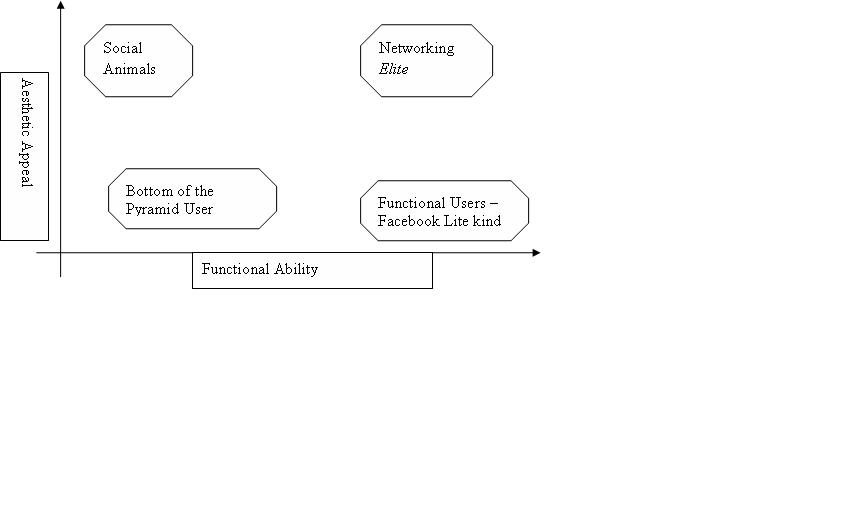
Going back to the six factors which I had mentioned before the ideas, I feel we could land up with some kind of user segmentation on the basis of these factors. Thus, we can club the six factors into two major categories as follows:

a. the intangible/aesthetic aspect: consisting of the UI experience, content diversity and the network effect

b. functional aspect: consisting of accessibility, availability of apps (easy navigation) and security

Thus the total user experience = aesthetic appeal x functional ability
IDEAS

Carrying on from the above thoughts, I have few ideas, which can potentially improve the UI experience of the user and also be monetized for financial viability.

Theme based UI: Though theme based UIs are already available and for free, the idea is to link ads for theme related activities and goods with the themes to create a holistic package which will then be available to the user. While the user uses the theme for free, the theme creator gets paid by the advertiser and the platform gets a share of the revenue based on the usage of the particular theme. While the theme creator is free to invite as many advertisers on their themes, they have to balance it with keeping the UI experience simple and unobtrusive to ensure user acceptance.

For example, with the growing following of Barclay’s Premier League in India, suppose the user in India is a fan of the Manchester United football club then he would select from one of the ManUtd themes available on the platform. The theme creators can tie up with advertisers of sports merchandise or agencies which can offer match tickets (with the possibility of these teams traveling to India in future). Taking this instance forward, it offers scope for the official website www.manutd.com another channel to reach out to its followers by broadcasting messages through widget based broadcast messages. Similar theme based activity can be used for popular artists, political and social causes etc.

Online Partying: While social networking gurus contemplate on the latent potential of the network, the origins of the phenomenon still reside in the fun and bonding aspect. So it is not difficult to imagine the potential of organizing online parties on the social media, with the DJ and related effects. The party can be by invitation, where you might need to authenticate your navigation onto a webpage, or simply walk-in, or click-in, and open for everyone in the network. The monetization model is similar to how it works offline, with a host bearing the expenses. The party-page can be visualized as having a shoutcast app, another app to post requests to the DJ and apps to create visual effects on the webpage, which will be visible to others in the party.

Similar to the offline scenario, this can give rise to party/event managers specializing in services for this genre of partying. The online party will be especially interesting for India as it has got a huge expatriate population and this provides them an occasion to join their families in the celebrations in a more personalized manner than just viewing a webcast.


P.S.>> Sorry for the images.. cdnt do a better job!!!

Monday, February 16, 2009

The Next Generation Boom in Services Industry


An article originally intended for L!VE, our student magazine @ SJMSOM:


Working in one of India’s leading software services exporters, what will be your reaction if you were to be transferred to Belapur? Confused. You shouldn’t be, if these are any indications of the times to come. Welcome to the next generation of expansion in the software service industry. The software industry of Bangalore, Mumbai and Gurgaon is now moving deeper into the country. The new centers of information technology are no longer the big metros but low cost centers like Jaipur, Trivandrum and Chandigarh.

Unsurprisingly, the high cost of operation in the metros coupled with the high rates of attrition prevalent among the leading companies has made them look other places for a better option. The Tier II cities have a distinct advantage in this regard for many companies. The reported cost differential is around 10 percent for non-voice based services and higher for voice based services create a huge margin of operational profits for the firms. Also, thanks to the large population of the country and increasingly effective education system, the number of university graduates coming from these cities is enough to take care of the major manpower requirements for the companies.

All major outsourcing companies have scouted out new locations, away from the hustling bustling metropolitans to locales such as Kochi, Baroda and Coimbatore etc. These include companies like Wipro Spectramind, Infosys Technologies and Cognizant Technology Solutions. Kochi and Coimbatore are coming up as feasible alternatives to Bangalore and Chennai in south, while Pune has already cemented its place in the outsourcing pantheons because of its close proximity to Mumbai and its rich educational system, providing close to 1,00,000 graduates every year, acting as an essential resource pool for the companies.

One another reason associated to moving to Tier II cities is the low cost of transportation involved in the cities, because of their small geographical stretches and comparatively low count of vehicles compared to outsourcing hubs. The average employee starting out in the service industry is a college graduate, who mainly relies on public transport for commutation to the workplace. As an unwritten rule, the companies have decided to include transportation costs as part of the compensation packages, providing for company buses and cabs, which again hit the operating margins of the companies. Though the outsourcing industry has funneled in loads of money into the metropolitan cities, the infrastructure development has been unable to maintain pace with the rapid growth and the lack of development in transport facilities are not helping the cause of these cities.

An additional impact of the gradual shift towards Tier II cities has been the entry of many smaller service providers, specially the ones catering to niche sectors like high-end data analysis. The Tier II and Tier III cities make the entry level costs of these companies substantially less and are fostering the entrepreneurship ventures of many technology specialists. The presence of sufficient talent pool in these cities helps these firms by reducing their attrition rates and hence, their training and recruitment costs are also going down, further promoting the cause of the Tier II cities.

However, all is not well with the migration plans of these companies. The primary concern of all the companies is the infrastructure related issues that generally accompany the Tier II cities. The doubt that whether the smaller cities will be able to rise over the infrastructure handicap and dicey connectivity, to actually make the small city boom happen still looms large in the minds of the senior management of many companies. It is estimated that 30% of the workforce of all leading IT/ITES companies is going to be based in these Tier II and Tier III cities. Hence the onus is on the respective public bodies to develop the amenities in these places to provide for the large workforce.

Another area of concern for the companies is bringing quality talent to these cities, especially with respect to the senior management and experience middle management employees, to these smaller cities. Obviously the promise of better work-life balance is not a good enough reason for these executives to relocate to these new situations and hence, companies might be forced to offer relocation bonuses or other such perks to facilitate the shift of work force to the new places. Also, an interesting trend that has been observed in the recent recruits is that, they do not want to leave the glitz and glamour accompanying a metropolitan city for relocation for some nondescript city offering little or no life outside office hours or during weekends.

Another major impact of this relocation to smaller centers in the country will be a more symmetric distribution of the outsourcing pie between the large hubs and the fast catching up wannabes. The recent years had seen a skew in favor of the metros, with the retail and real estate booms in the city projecting them as the face of modern India. These recent developments will enable the smaller players in this field to develop their own identity in this market and present a more representative picture of modern India. Already signs to this effect are visible with an increase in spending by real estate giants in these centers and the entry of retailing giants like Reliance and Big Bazaar in these cities. The development of these new consumption centers is also good for related sectors of manufacturing and allied services, giving them further impetus for growth.

However, none of this is going to happen in near future. The challenges are still clear for all of us to see. Firstly, the infrastructure needs a great impetus from the government. It is heartening to see projects like the Golden Quadrilateral being visualized because they will improve connectivity of the smaller cities with the outsourcing hubs. Also, the telecom revolution in the country should help ensure that the network and data connectivity are maintained at requisite levels for the companies to show confidence in these cities. Finally, the public amenities need to be improved to attract the skilled labor into these cities rather than switching jobs in the major cities themselves. The rise of latent talent and potential in the smaller cities is not under any sort of doubt, it is just the timing of the event that is debatable. The sooner it happens, the better.